Ruby 1.9 Fibers are touted as lightweight concurrency elements that are much lighter than threads. I have noticed a sizbale impact when I was benchmarking an application that made heavy use of fibers. So I wondered what If I switched to threads instead? After some time fighting with threads I decided I needed to write something specific for this comparison. I have written a small application that would spawn a number of fibers (or threads) and then would return the time went into this operation. I also recorded the VM size after the operation (all created fibers and threads are still reachable, hence, no garbage collection). I did not measure the cost of context switching for both approaches, may be in another time.
Here are the results for creation time:

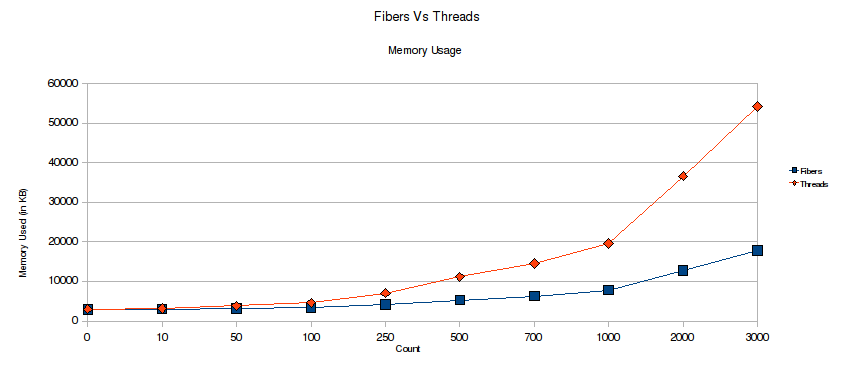
And the results for memory usage:
Conclusion
Fibers are much faster to create than threads, they eat much less memory too. There is also a limit on the number of threads for 1.9 as I maxed on 3070 threads while fibers were not complaining when I created 100,000 of them (but they took 203 seconds and occuppied a whoping 500MB of RAM).

 Oldmoe's blog
Leave a reply to roger Cancel reply